
Business Model vs Business Idea: Why Great Ideas Still Fail
Having a great idea is only the beginning. The businesses that survive are built on business models that customers are willing to pay for.

Business Idea vs Business Model: Why Great Ideas Still Fail
Ideas arrive easily.
Someone struggles to find parking.
Another person can’t get affordable healthy meals delivered.
A freelancer gets frustrated sending invoices manually.
Suddenly, the sentence appears.
“Someone should build something for this.”
That moment feels like entrepreneurship.
It isn’t.
It’s just observation.
The real work begins after the idea.
Because businesses aren’t built on ideas. They’re built on business models.
And confusing the two is one of the biggest reasons promising businesses never survive beyond their first few years.
A Business Idea Solves a Problem. A Business Model Builds a Company.
An idea answers one question.
What problem should we solve?
A business model answers several others.
Who exactly will pay for this?
Why would they choose us instead of existing alternatives?
How will we consistently reach them?
Can we deliver profitably?
Can the business continue growing without costs growing at the same pace?
Many founders spend months refining products before answering these questions.
That’s backwards because customers don’t reward effort. They reward value.
A fantastic product with no viable business model is simply an expensive hobby.
That’s why two businesses can sell almost identical products while one thrives and the other quietly disappears.
The difference is rarely the idea. It’s how the business is designed to create, deliver and capture value.
The Businesses That Win Test Assumptions, Not Just Products
One mistake entrepreneurs make is assuming that because friends like an idea, customers will too.
Validation goes much deeper.
You’re not testing whether people think your idea is interesting.
You’re testing whether they’ll exchange money for it.
This is why many successful founders launch imperfect products.
They’re collecting evidence.
They want to know:
-
Are people willing to pay?
-
Which customers benefit most?
-
What objections keep appearing?
-
Which marketing channels actually work?
-
Can the business acquire customers profitably?
These answers shape the business model far more than another six months spent perfecting the product.
Case Study: Paystack Didn’t Just Build Payments. It Built a Better Business Model.
When Paystack entered Nigeria’s payment industry in 2015, online payments already existed. The challenge wasn’t the absence of payment gateways. It was how difficult they were for businesses to integrate and use.
Rather than trying to invent an entirely new idea, Paystack focused on making online payments faster for developers, simpler for businesses and more reliable for customers. It invested heavily in documentation, developer experience and seamless onboarding, making it significantly easier for businesses to accept digital payments.
The product mattered.
But the business model mattered just as much.
Every new business that integrated Paystack strengthened its network, increased transaction volume and created recurring revenue through transaction fees. Instead of chasing one-time sales, the company built a model that became more valuable as more businesses joined the ecosystem.
That combination eventually attracted Stripe, which acquired Paystack in 2020 in a deal reportedly worth over $200 million.
Paystack didn’t become valuable because it had the first payment idea.
It became valuable because it designed a business model people wanted to keep using.
Your Business Model Is Bigger Than Your Product
Many entrepreneurs think their product is the business.
It’s only one part.
A strong business model considers questions many founders postpone until it’s too late.
How will customers discover you?
What keeps them coming back?
Can your pricing sustain the business?
Can your operations handle growth without quality dropping?
Can someone else deliver the service if you aren’t available?
These questions determine whether your business becomes scalable or simply becomes busier.
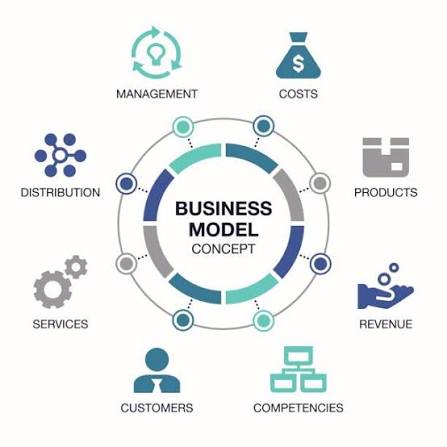
One useful framework many entrepreneurs rely on is the Business Model Canvas, which breaks a business into key building blocks such as customers, value proposition, revenue streams, channels, key resources and partnerships. It helps founders stress-test an idea before investing heavily in it.
Because changing a business model on paper is cheap.
Changing one after spending millions is not.
Don’t Fall in Love With the Idea. Build the System Instead.
Entrepreneurs often protect ideas as though they’re the most valuable part of the business.
They’re usually not.
Execution matters.
Distribution matters.
Pricing matters.
Customer retention matters.
Cash flow matters.
Without those pieces working together, even brilliant ideas struggle to survive.
The businesses that endure rarely succeed because they had the most original idea.
They succeed because they built systems capable of delivering value consistently, profitably and repeatedly.
That’s the difference between having an idea and building a business.
Ideas spark companies.
Business models keep them alive.