
Business Model Canvas: How to Design a Business That Works
Your product is only one part of your business. The real advantage comes from how every piece works together.

Business Model Canvas: How to Design a Business That Works
Some businesses feel like carefully engineered machines. Every part supports another. Customers know where to find them. The product solves a real problem. The pricing is good. Operations run smoothly. Revenue keeps coming in.
Then there are businesses that feel like nine separate ideas trying to coexist.
The founder is constantly fixing one problem after another. Sales improve but operations collapse. Marketing works but customer retention doesn’t. Demand increases but profits barely move.
Nothing is technically broken. Everything simply isn’t connected.
That’s the real job of a business model canvas. Designing a business where every important decision strengthens the next one.
Businesses Don’t Grow in Pieces. They Grow as Systems.
Many entrepreneurs think about their businesses one department at a time.
“I need more customers.”
” We should improve my product.”
“I need better marketing.”
Those are valid concerns.
But businesses rarely fail because of one weak area. They fail because the different parts don’t reinforce each other.
Imagine opening a premium fashion brand. You invest in luxury packaging, hire talented designers and create beautiful products. Then you sell almost exclusively through discount marketplaces where customers compare prices.
Nothing about that business supports your premium positioning.
Or imagine running an online course business with exceptional content but no email system to nurture prospects after they download your free guide.
Great product.
Weak system.
The strongest businesses aren’t built by solving isolated problems.
They’re built by making sure every decision supports the next. That’s exactly what the Business Model Canvas helps entrepreneurs visualise.
Business Model Canvas: Think Beyond the Product
One reason the Business Model Canvas has become one of the world’s most widely used business frameworks is that it forces founders to stop obsessing over the product.
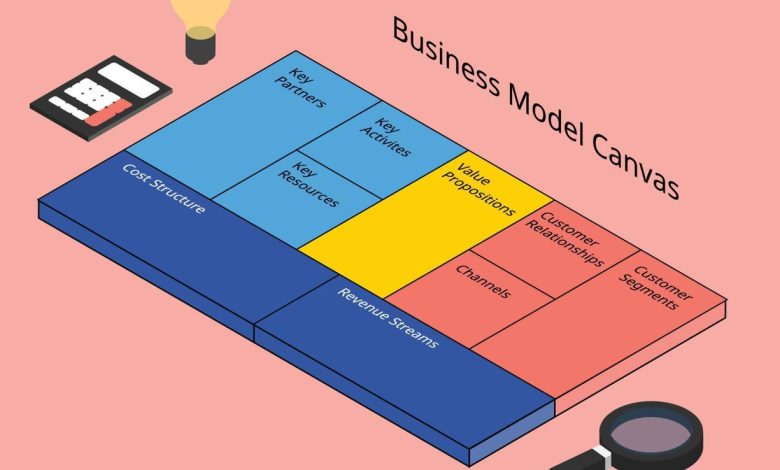
Instead, it asks nine simple but powerful questions.
- Who exactly are your customers?
- What unique value are you creating for them?
- How will they discover you?
- How will you build relationships with them?
- How will your business make money?
- What resources must you own?
- What activities must you perform exceptionally well?
- Who should you partner with instead of doing everything yourself?
- What will it actually cost to deliver all of this?
Notice something that only one of those questions is about the product itself.
The rest focus on building a business that can consistently create and capture value.
That’s a shift many entrepreneurs need to make.
Customers don’t buy products. They buy outcomes.
Businesses don’t survive on products. They survive on systems.
Case Study: Netflix Didn’t Change Movies. It Changed Its Business Model Canvas.
Netflix is often praised for disrupting entertainment. But its biggest innovation wasn’t producing better films. It was redesigning the business model.
DVD rental companies earned money each time customers rented a movie. Late return fees became a major source of revenue.
Netflix removed the friction.
Instead of charging per rental, it introduced a subscription model that gave customers unlimited access for one monthly payment. Later, it shifted again into streaming, removing the need for physical DVDs altogether.
The customer segment evolved.
So was the value proposition improved.
The distribution channel became digital.
Revenue moved from one-off transactions to recurring subscriptions.
Technology became the key resource.
Original content became a key activity.
Every building block evolved together.
Netflix didn’t simply launch a better product.
It redesigned the entire business system.
That’s why Blockbuster struggled to compete.
Its challenge wasn’t the movie library.
It was the business model.
Your Business Is Already Designed. The Question Is Whether You Designed It Intentionally.
Every business has a business model.
Even if the founder has never heard of the Business Model Canvas.
The difference is intentionality.
Some businesses grow by accident.
Others grow by design.
The Business Model Canvas gives entrepreneurs a way to see connections they would otherwise miss.
A pricing problem may actually be a customer segment problem.
One marketing problem could really be a weak value proposition.
Poor profitability may come from an expensive cost structure rather than low sales.
Instead of solving symptoms one at a time, founders begin seeing how every decision affects the entire business.
That’s where smarter strategy begins.
Not with another product idea. But with a better business design.
The entrepreneurs who build lasting companies rarely have perfect ideas from day one.
What they have is a willingness to test, adjust and redesign until every part of the business starts working together.