

CBN’s 306th MPC meeting retains interest rate at 26.5%
Inflation declined to 15.91% as CBN held rates at 26.5% amid global energy risks

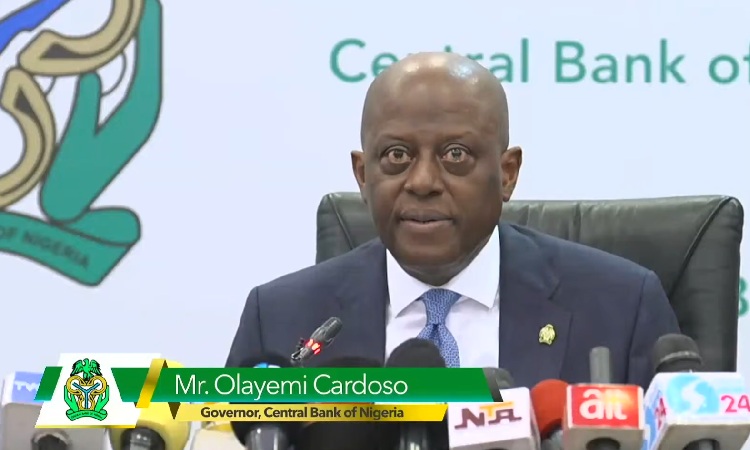
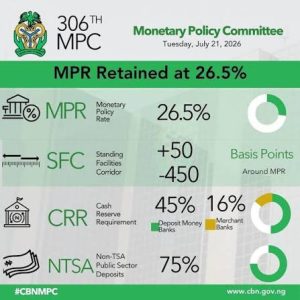
The Monetary Policy Committee (MPC) of the Central Bank of Nigeria (CBN) has opted to maintain its current monetary policy stance, holding the Monetary Policy Rate (MPR) at 26.5% following its 306th meeting held on July 20 and 21, 2026.
Key Policy Decisions
In addition to holding the benchmark interest rate, the committee, led by the CBN Governor, decided to retain the following parameters:
- Standing Facilities Corridor: Set at +50 to -450 basis points around the MPR.
- Cash Reserve Requirement (CRR): Maintained at 45% for deposit money banks and 16% for merchant banks.
- Non – TSA Public Sector Deposits: remain at a CRR of 75%.
Inflationary Trends and Global Risks
The decision to stay the course comes as headline inflation showed a marginal decline to 15.91% in June 2026, down from 15.93% in May. This marks the end of three consecutive months of price hikes. While core inflation moderated to 15.92% due to exchange rate stability, food inflation continued to climb, reaching 17.52% as a result of supply constraints and high transportation costs.
Despite the domestic moderation, the MPC expressed caution regarding heightened global uncertainties, specifically citing renewed hostilities in the Middle East. The committee noted that these tensions could trigger a spike in global energy prices, potentially passing through to domestic inflation.
Economic Growth and External Reserves
The Nigerian economy has shown resilience, with Real GDP expanding by 3.89% in the first quarter of 2026. Growth was primarily driven by the non-oil sector, which grew by 3.94% buoyed by strong performances in telecommunications, financial services, and trade. Conversely, the oil sector saw a decline in growth to 2.57%, attributed to maintenance activities on oil facilities.
On the external front, Nigeria’s gross external reserves rose to $52.52 billion as of July 17, 2026. This provides approximately 11 months of import cover, significantly exceeding the international benchmark of three months.
Banking Sector and Structural Reforms
The Governor highlighted the successful conclusion of the banking sector recapitalization exercise, announcing that 33 out of 37 banks met the new capital thresholds. Most of this capital was raised from domestic sources. The committee also addressed a recent 14.8% drop in lending, clarifying that this was a temporary result of banks recalibrating their portfolios after the end of COVID-era regulatory forbearance.
To modernize the financial system, the CBN has introduced the Nigeria Overnight Financial Rate (NOFR). This new risk-free benchmark is designed to align Nigeria with international standards, replacing judgmental rates with actual transactional data to improve transparency.
Future Outlook
The MPC reaffirmed its commitment to reaching single-digit inflation by 2027, despite unanticipated global shocks. The committee underscored the importance of the government’s Executive Order 9 and efforts to boost crude oil production and solid mineral earnings to strengthen macroeconomic fundamentals. The next MPC meeting is scheduled for September 21 and 22, 2026.