

Swipe Right for Opportunity: Nigeria’s POS Revolution
How Mobile Money Agents are Rewriting Nigeria's Youth Unemployment Story

Every morning, as the sun begins to rise in Benin City, Nigeria, 28-year-old Tonia Osakwe rolls up the tarpaulin covering her small kiosk at the Dawson/Akpakpava roads intersection, dusts off her Point of Sale(POS) machines, and prepares for a long day ahead.
Dressed in a neat yellow blouse and jeans on this day, Osakwe greets early customers, mostly traders, commuters, and passersby, who are looking to withdraw or transfer cash.
For many, Osakwe has become the face of accessible banking in the neighbourhood.
Just a few years ago, she was battling anxiety and hopelessness after graduating with a degree from the University of Benin. Despite several attempts to secure employment, she was repeatedly turned down.
“I kept going to interviews, submitting curriculum vitae, hoping someone would take a chance on me; however, nothing came through.”
In 2021, Osakwe heard about a mobile money training session organised by a financial technology (fintech) company in the city.
With a N50,000 loan from a family friend, she started a POS business under a wooden shed; today, she has two kiosks and employs another young woman.
“It is not just a job; it is a second chance; I did not find work; I created one,” she said, beaming with pride.
Similarly, in a bustling corner at the Oba of Benin market, 32-year-old Joshua Uche’s kiosk hums with activity.
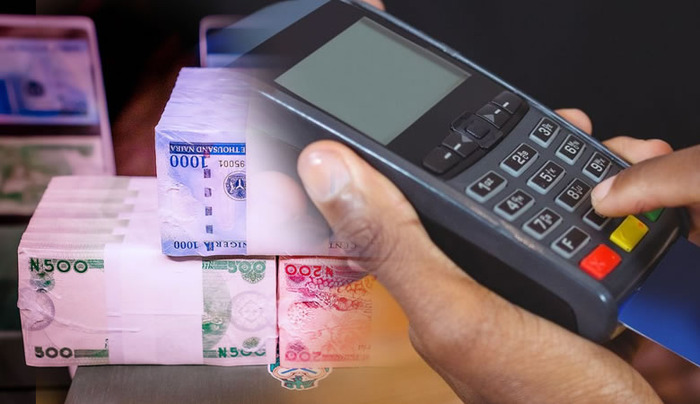
Beneath the umbrella shading his stand, he punches numbers into a POS terminal, handing naira notes to a customer who just transferred money from her phone.
“This small machine saved me from roaming the streets; before this, I had no job for almost two years.”
As a POS operator and mobile agent, he caters to personal and family needs.
“My father wanted me to become a civil servant like him, but after three years of no job, I couldn’t wait anymore.”
Uche raised capital from personal savings and family donations to purchase a second-hand terminal and set up a roadside POS stand.
“Now, I make around N7,000 daily,” he said.
Uche noted that he supported his younger siblings’ school fees through the business.
At the edge of a busy junction in Ganmo, on the outskirts of Ilorin, Kwara capital, sits a neatly dressed young man, Muhammed Ayinde, greeting customers with a calm smile as he punches digits into a POS device.
For many passersby, Ayinde is just another agent offering quick cash services; but for him, this humble wooden booth represents something far greater: a stepping stone to academic achievement and personal transformation.
“In 2020, I had almost given up; I had a degree, dreamt of further studies, but no job to fund them; then my uncle introduced me to the POS business; that was how everything started,” Ayinde also recounted.
Like thousands of Nigerian youth caught in the chokehold of unemployment, he found a lifeline in the country’s expanding digital payment system.
Setting up his first kiosk in 2021, he learnt the ropes quickly – how to manage customers, resolve failed transactions, and stay afloat in an increasingly competitive market.
Four years later, not only has the POS business become a reliable source of income, but it has also helped him fund a Master of Science degree in Mass Communication at the University of Ilorin.
He now operates with two terminals and employs two other young men who also rely on the business to make ends meet.
“This business gave me back my dignity; while others waited for white-collar jobs, I built something sustainable; I am not just earning; I am learning, growing, and giving back,” he said.
Muhammed’s story is a testament to how digital payments are not only helping young Nigerians survive but also achieve upward mobility in a fragile economy.
According to the National Bureau of Statistics (NBS), youth unemployment in Nigeria stood at over 6.5 per cent as of the second quarter of 2024, dropping from the all-time high of 53.4 per cent at the end of 2020, when POS business was less common.
Across the country, young Nigerians like Osakwe, Uche, and Ayinde are rewriting their economic stories through the growing digital payment ecosystem.
With youth unemployment hovering at high levels, many have turned to POS services and mobile money operations to survive and thrive in a harsh job market.
From the busy alleys of Lagos and Abuja to remote towns in Kwara, Edo,o and Kano, Nigeria’s digital finance ecosystem is becoming more than just a convenience; it is turning into a survival strategy.
The rise of digital payments has changed daily life, sparing countless residents the exhausting, hours-long journeys once required just to complete a simple banking transaction.
Today, financial services are no longer a distant dream, they are just a few steps away, at a neighbourhood agent’s kiosk.
“I used to travel far to the nearest bank just to collect small money; now, with these POS terminals on our street, I can withdraw or send money easily without stress.
“They have changed our lives,” Mrs Morufat Eniola, a petty trader in Ilorin, said.
For Mr Joe Egbon, a farmer in Benin, the services go beyond withdrawals.
“I pay for my fertiliser and seeds through these agents. Without them, it would take me a whole day to reach a bank. They make business faster for us,” he said.
Electronic transactions form crucial components of Digital Public Infrastructure (DPI); others include digital identity and data exchange systems,whicho, undoubtedlyy, have transformed how people access essential national services.
Nigeria has a long way to go to deepen these elements. However, the progress being made in digital payments gives hope to some.

For instance, the Nigeria Inter-Bank Settlement System (NIBSS) reports that more than 5.5 million POS terminals have been deployed across the country as of December 2024, doubling the 2.4 million recorded at the end of 2023.
In 2024 alone, over N18 trillion worth of POS transactions were recorded.
The vast majority of those behind these transactions are young Nigerians like Ayinde, Osakwe and others, many of whom are unemployed or underemployed graduates or school leavers, who have found in digital payments what the formal economy denied them.
The rise of mobile money and POS services is not only reducing youth unemployment; it is also contributing to financial inclusion.
According to the Central Bank of Nigeria (CBN), more than 38 million adults in Nigeria remain unbanked, with a significant number living in rural areas.
By setting up POS stands in marketplaces and underserved communities, young agents are bridging the financial gap for millions; they facilitate cash withdrawals, bill payments, airtime purchases, transfers, and even micro-savings, often becoming the only bank their communities can access.
For Ali Bello, who engages in POS operations in Benin, a city far away from his hometown, Kano, building a personal house was possible courtesy of the digital financial service business.
“I did not go to school; I am just a secondary school leaver who came to Benin from Kano alongside other friends, in search of greener pastures.
“While others are engaged in cloth selling and bureau de change business amongst others, I opted for POS services.
“I thank God, I am making it here, catering for daily needs as well as family obligations.”
However, the journey is not without its thorns; many agents report daily struggles with poor internet connectivity, frequent transaction failures, and high service charges that eat into profits.
Many operators express confusion over shifting regulations and multiple transaction charges imposed by the Central Bank of Nigeria (CBN).
“We need clear policies that do not change overnight; for instance, besides the transaction charges incurred from cash transfer to another account, any cash inflow more than N10,000 attracts N50 electronic money transfer levy,” Bello said.
To him, the levy amounts to a double charge as both the sender and the receiver are charged for a single transaction.
He called on the government to review the charges so as to encourage more people to embrace the digital payment system.
Nonetheless, the digital finance industry continues to grow; fintech companies like OPay, Moniepoint, and PalmPay have rapidly expanded agent networks, offering flexible account setups and low-cost terminals.

In 2024 alone, Nigerian fintech startups attracted over $2 billion in venture capital funding, making the sector the most funded in Africa that year.
Experts believe the sector’s true potential lies in its ability to create micro-economies across communities; one of such experts is Hussein Olarewaju, founder of HAQ Technology Management Services.
Olanrewaju, who is among the first 30 aggregators (agent managers) in Nigeria, says the digital financial solutions address the gap in traditional banking systems.
More so, fintech innovations like Moniepoint, which the founder helped develop, have multiplied job opportunities by creating layered structures where agents recruit, manage, and mentor others across states and regions.
“Seizing this opportunity, HAQ Technology built a network that used local agents – familiar faces within communities – to deliver banking services.
“This strategy not only increased financial inclusion but also created employment opportunities for young people tasked with managing the agent locations.
oToday more than 500,000 to 1 million POS and mobile money agent points exist across Nigeria; many built on this very structure pioneered by HAQ Technology.
“Each agent point typically employs at least one to two staff, translating into hundreds of thousands of youth gaining reliable incomes in a country where youth unemployment stood at over 50% in 2023,” the fintech expert said.
Besides the high cost of transactions, which Olanrewaju also buttresses as being one of the constraints in digital financial services, the expert also identified financial illiteracy, particularly among the rural dwellers as another issue in deepening the payment system.
He emphasises that real financial literacy requires face-to-face interaction at the grassroots level, not just radio jingles or TV ads.
According to him, agents such as trusted community members hshouldbe empowered to provide direct education to customers.
To ensure that digital financial services continue to empower youth and grow the economy, he advocates field-informed regulation, in which regular feedback from agents and aggregators informs the Bank policies to make them practical and impactful at the grassroots.
Notably, as Nigeria leans further into a cashless future, it is young men and women like Osakwe, Uche, Ayinde, Bello a,nd Olanrewaju, who are quietly building the infrastructure – one swipe at a time.
In the absence of formal jobs, some young people are creating their own; and in doing so, they are not just surviving, they are reshaping the very meaning of work and opportunity in Nigeria’s economy.
To sustain this momentum, stakeholders are calling for targeted government policies that support young operators, including improved access to credit, investment in network infrastructure, and training on cybersecurity. (NANFeatures)
This report is produced under the DPI Africa Journalism Fellowship Programme of the Media Foundation for West Africa and Co-Developed.
By Usman Aliyu, News Agency of Nigeria (NAN)