

Africa’s quest for a permanent seat on the United Nations Security Council presents a defining test of whether global governance can match its commitment to equality with the realities of international power.
China’s renewed support for the continent’s campaign has given the longstanding demand fresh diplomatic visibility.
However, beyond the symbolism of Beijing’s endorsement, questions remain about whether the growing calls for reform can overcome the political and institutional obstacles to expanding the council.
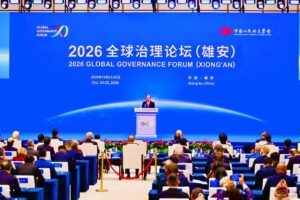
At the 2026 Global Governance Forum in Xiong’an, China, President Xi Jinping called for reforms to global governance that would strengthen the representation of developing countries, especially Africa, on the UN Security Council.
Xi’s message, delivered by Foreign Minister Wang Yi, reinforced Beijing’s position that international institutions must adapt to changing geopolitical realities and give developing countries a greater voice in global decision-making.
The three-day forum, which ended on Oct. 25, attracted participants from more than 90 countries under the theme, “Rebuilding Confidence and Cooperation: Reforming and Improving Global Governance in a Transforming World”.
Its outcome document, Global Governance: Xiong’an Vision, outlined more than 450 proposals addressing international cooperation, peace, development, technology and institutional reform.
For Africa, the discussions go beyond diplomatic symbolism.
The continent remains without a permanent seat on the Security Council, the UN organ primarily responsible for maintaining international peace and security.
Established in 1945, the council comprises 15 members, including five permanent members of China, France, Russia, the United Kingdom and the United States.
While the five permanent members possess veto powers over substantive resolutions, the remaining 10 members are elected by the General Assembly for two-year terms.
Consequently, Africa’s 54 UN member states remain excluded from permanent membership, in spite of the continent’s significant representation within the organisation and its involvement in issues frequently considered by the council.
This imbalance has become a recurring concern among African leaders, who argue that the continent’s exclusion undermines the council’s legitimacy and weakens confidence in international decision-making.
UN Secretary-General António Guterres has also called for reform, saying Africa’s continued absence from permanent membership is “unjust and indefensible”.
Similarly, President of the UN General Assembly’s 81st session, Khalilur Rahman, has argued that the organisation’s survival for eight decades should not be mistaken for institutional success.
Rahman noted that UN membership had expanded from 50 countries in 1945 to 193, while the distribution of permanent power remained largely unchanged.
“Africa needs a seat at the table, not to be on the menu,” he declared, underscoring the continent’s demand for meaningful participation in decisions affecting international peace and security.
Against this backdrop, Africa’s common position is articulated through the Ezulwini Consensus, adopted by the African Union (AU) in 2005, and the Sirte Declaration, which established a common negotiating framework.
The position demands at least two permanent Security Council seats and five non-permanent seats for Africa.
It also calls for the same prerogatives and privileges enjoyed by existing permanent members, including veto powers for African permanent members while the veto remains in place.
African leaders have consistently maintained that the distribution of global power established in 1945 cannot adequately address the political and security realities of the present day.
Nigeria’s President Bola Tinubu, represented by Vice-President Kashim Shettima at the 81st session of the UN General Assembly (UNGA), reaffirmed the country’s support for the Ezulwini Consensus and Sirte Declaration.
Tinubu said the council’s authority to speak on behalf of humanity should be matched by a commitment to equitable representation.
“The authority to speak for humanity carries an obligation to represent it,” he said.
Similarly, South Africa’s Minister of International Relations and Cooperation, Ronald Lamola, argued that restoring confidence in multilateralism required meaningful Security Council reform.
Addressing the UNGA, Lamola maintained that legitimate international leadership depended on equitable representation.
Kenyan President William Ruto offered another pointed assessment, describing Africa as “permanently discussed, yet permanently excluded” from the council’s highest level of decision-making.
Ghana’s President John Mahama also argued that reform was essential to the UN’s legitimacy, credibility and survival, rejecting suggestions that Africa was seeking preferential treatment.
“Africa does not seek charity. Africa seeks equal partnership anchored in mutual respect,” Mahama said, demanding permanent representation with full rights and veto powers.
In the same vein, Burundi’s President Évariste Ndayishimiye said Africa must be listened to more, better represented and more closely involved in decisions shaping the future of the world.
Liberian President Joseph Boakai also described the continent’s exclusion from permanent membership as a historical injustice that could no longer be justified.
He argued that Africa’s population of approximately 1.5 billion and its contributions to international peace and security strengthened its case for permanent representation.
Nevertheless, broad continental support for reform does not automatically resolve the practical questions surrounding the campaign.
African governments must still agree on how permanent seats would be allocated, how representatives would be selected and how the continent’s interests would be coordinated.
This is where China’s support becomes significant, but also where its limitations become apparent.
Beijing’s endorsement could help sustain international attention on Africa’s demand and strengthen calls for a more representative multilateral system.
However, diplomatic solidarity alone cannot deliver the institutional changes required to secure permanent African representation.
China’s position is linked to President Xi’s Global Governance Initiative, unveiled in September 2025, which promotes sovereign equality, multilateral cooperation, shared responsibility and a more equitable international order.
The initiative calls for improvements to global governance arrangements and greater participation by developing countries in international institutions.
China has also presented platforms such as BRICS and the Shanghai Cooperation Organisation as channels for strengthening cooperation among developing countries.
From Beijing’s perspective, institutions cannot command universal confidence if their decision-making structures fail to reflect the interests of countries and populations affected by their decisions.
Even so, China’s endorsement does not guarantee that Africa will secure a permanent seat.
The decisive challenge lies in translating political support into an agreement acceptable to the wider UN membership, including all five existing permanent members.
Under Article 108 of the UN Charter, amendments require approval by two-thirds of the General Assembly and ratification by two-thirds of UN member states, including all five permanent members.
This requirement gives the existing permanent members considerable influence over the prospects for reform.
Negotiations must also address difficult questions about the number of additional seats, veto powers, regional representation and the distribution of authority within an enlarged council.
In practical terms, winning international support for Africa’s proposal is different from securing the political consensus needed to implement it.
For the continent, this distinction makes sustained coordination among African governments, the AU and diplomatic partners essential.
Competition among prospective African candidates could complicate negotiations if national ambitions take precedence over the agreed continental position.
Moreover, China’s support will be more consequential if it translates into sustained engagement in negotiations and cooperation with other influential countries to advance a workable reform framework.
The Xiong’an forum also placed Security Council reform within wider debates about development financing, international trade, climate change and technological inequality.
These issues are relevant to Africa because decisions on debt, investment, peacekeeping, migration and climate finance can significantly influence the continent’s development prospects.
Speaking at the closing ceremony, Wu Ken, President of the Chinese People’s Institute of Foreign Affairs, said the forum had generated more than 450 proposals for improving international cooperation, multilateralism and global governance.
“We are of the view that the world today is entering a new period of turbulence and transformation.
“In face of growing and increasingly severe global challenges, the call for reforming and improving the global governance system is getting stronger, and the task, more urgent.
“The earlier the international community acts together, the better it is for the whole world,” Wu said.
The forum’s outcome reinforces the argument that reforming global governance has become a wider international concern.
However, the number of proposals generated and the breadth of participation do not, by themselves, establish that governments have reached agreement on Security Council enlargement.
Ultimately, the central question is whether diplomatic declarations can produce a binding agreement that changes the council’s composition and distribution of power.
China has amplified Africa’s demand, but the outcome will depend on sustained negotiations, African unity and compromises among countries with competing interests.
For Africa, the objective is not simply to occupy a permanent seat, but to exercise meaningful influence over decisions affecting international peace, security and development.
For the UN, reform offers an opportunity to demonstrate that multilateralism can evolve beyond the power arrangements of 1945 and better reflect the world it serves.
Credit NAN: Texts Excluding headlines