


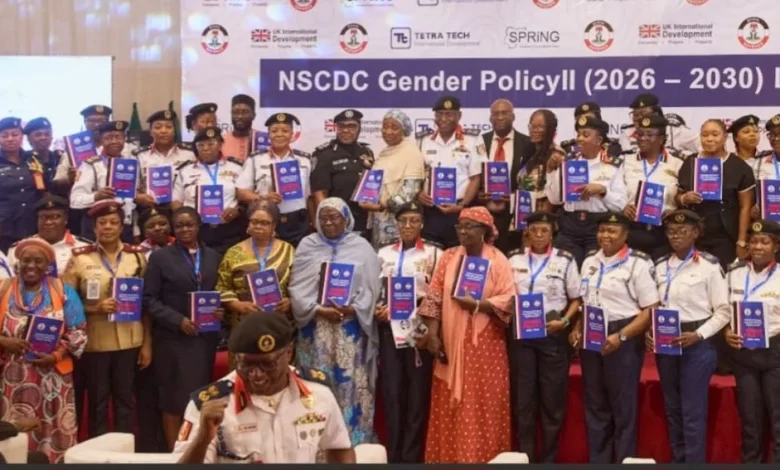
A UK-funded programme, Strengthening Peace and Resilience in Nigeria (SPRiNG), has partnered with the Nigeria Security and Civil Defence Corps (NSCDC) to unveil the Corps’ revised Gender Policy 2 for the 2026–2030 period.
The policy was inaugurated on Tuesday in Abuja, according to the News Agency of Nigeria (NAN).
Speaking at the launch, the Team Leader of the SPRiNG Programme, Dr Ukoha Okiwo, said the partnership was aimed at strengthening government institutions, security agencies and community actors involved in peacebuilding and security.
Okiwo explained that SPRiNG’s focus was to help institutions deliver services in a more inclusive, participatory, transparent and accountable manner. According to him, such an approach would build public trust and reduce the tendency for citizens to resort to self-help, which often leads to violence.
He noted that a major aspect of SPRiNG’s work was promoting the participation of women, youths, persons with disabilities and minority groups in peacebuilding, governance and public life.
Okiwo added that the programme was also keen on working with security agencies to ensure civilian protection, respect for human rights and improved relationships between security personnel and communities.
He said the adoption of the NSCDC Gender Policy aligned with Nigeria’s Third National Action Plan on Women, Peace and Security, as well as plans to introduce a National Action Plan on Youth, Peace and Security.
According to him, the policy would strengthen the NSCDC’s role in prevention, protection, reporting and prosecution, particularly in cases involving sexual and gender-based violence.
Also speaking, the Deputy High Commissioner of the British High Commission in Abuja, Ms Gill Lever, commended the NSCDC for its commitment to gender responsiveness.
Lever said the revised policy was inclusive and evidence-based, addressing emerging issues such as technology-facilitated gender-based violence, disability inclusion, and gender-responsive budgeting.
She stressed that policies were only effective when implemented, adding that strong leadership, adequate resources and collective accountability were needed to translate the document into action.
Lever further highlighted the importance of women’s inclusion in governance and security, noting that women remained underrepresented in Nigeria’s political and public life despite making up nearly half of the population.
Representing the Minister of Interior, Dr Olubunmi Tunji-Ojo, the Commandant General of the NSCDC, Prof. Ahmed Audi, said the Corps pioneered the first gender policy in the security sector to promote inclusion.
He explained that gaps identified over time necessitated a review, leading to the introduction of the second gender policy, and commended SPRiNG for its support.
Audi said the policy had already improved women’s participation within the Corps and would further strengthen equal opportunities.
In her remarks, the Minister of Women Affairs, Hajiya Imaan Suleiman-Ibrahim, represented by a director, Ms Ola Erinfolami, described the policy as a key step towards building a more inclusive and effective security sector.
She urged stakeholders to support its full implementation.