
Türkiye plans $5bn bilateral trade with Nigeria — Envoy
Türkiye, Nigeria explore pathways to $5bn trade

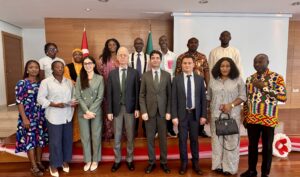
Türkiye has set a target of increasing its bilateral trade volume with Nigeria from the current $2 billion to $5 billion, its Ambassador to Nigeria, Mehmet Poroy, has said.
Poroy disclosed this during a meeting with journalists in Abuja on Monday evening to commemorate the 66th anniversary of the elevation of diplomatic relations between Nigeria and Türkiye to ambassadorial level.
He said the target was part of efforts to strengthen economic ties between both countries following President Bola Tinubu’s visit to Türkiye earlier in the year.
According to him, the presidential visit, which included nine Nigerian ministers, provided an opportunity to explore areas of mutual cooperation, resulting in the signing of nine agreements and memoranda of understanding.
“We need to increase our bilateral trade. Indeed, this is the instruction given to us by our presidents during this presidential visit.
“The goal is to have five billion dollars in bilateral trade,” he said.
The ambassador explained that trade between both countries currently stood at approximately $2 billion, including oil and gas, describing the figure as relatively low compared with Nigeria’s economic potential.
He noted that Türkiye’s total trade with African countries was about $37 billion, while its trade with Nigeria accounted for only $2 billion.
“There is room for improvement. This is the same in terms of investments.
“Taking into account the huge economic potential that Nigeria offers, we have a lot of things to do,” he said.
Poroy said Türkiye had engaged chambers of commerce in Abuja, Kano, Kaduna and Lagos to identify practical ways of expanding business relations.
He added that his country had introduced simplified visa procedures for businesspeople to encourage direct business-to-business engagements.
On security cooperation, the envoy said Türkiye was working with Nigeria to strengthen its military capacity through equipment supplies, training and possible local production facilities.
He noted that the Nigerian military already deployed Turkish attack helicopters and drones in operations against insecurity, particularly in northern Nigeria.
“We are planning to have some local production unit also in that context, not only selling to Nigeria the tools, equipment and arms that it needs, but also the possibility of having local production here in Nigeria,” he said.
Poroy disclosed that about 200 Nigerian special forces personnel were undergoing a two-month training programme in Türkiye.
He said both countries were also considering establishing a military training facility in Nigeria to provide continuous local training for Nigerian personnel with the support of Turkish officers.
According to him, Türkiye was willing to share its counterterrorism experience, having spent about four decades confronting terrorism, during which it lost more than 40,000 people.
“Security is important for other issues also. If you are a secure, stable country, then you may have more developed relations,” he said.
On humanitarian assistance, Poroy said the Turkish government had provided food support to 3,000 families displaced by insecurity in Adamawa.
He added that Turkish humanitarian organisations had supported vulnerable communities across Nigeria, particularly through food distribution during Ramadan and Eid al-Adha.
The ambassador said Turkish non-governmental organisations and the Turkish Religious Affairs Foundation spent approximately $5 million on humanitarian and food-related interventions in Nigeria in the past year.
He said the assistance demonstrated the willingness of the Turkish people to support communities in need, adding that both countries would explore ways to coordinate such interventions more systematically with Nigerian authorities.
Poroy also disclosed that Turkish Airlines planned to increase its weekly flights between Nigeria and Istanbul to improve connectivity and facilitate movement between both countries.
He said improved air links would promote business engagements, trade, investment and people-to-people exchanges.
On the historical relationship between both countries, the envoy recalled that Türkiye elevated its diplomatic relations with Nigeria to ambassadorial level on November 9, 1960, about one month after Nigeria gained independence.
He clarified that the first Turkish Consulate-General was established in Lagos on April 19, 1959, while Türkiye’s first ambassador arrived in Nigeria in 1962.
He explained that the 66th anniversary marked the formal elevation of diplomatic relations rather than the arrival of the first ambassador.
Poroy also traced historical contacts between the Ottoman Empire and the Kanem-Borno Sultanate to the 16th century, citing archival correspondence between the Ottoman Sultan and rulers of the sultanate.
He said the correspondence included instructions to Ottoman authorities to facilitate visits by Kanem-Borno delegations to Istanbul and ensure their protection during their journeys.
The ambassador further recalled the Ottoman Sultan’s involvement in the opening of the Shitta Bey Mosque in Lagos in the late 19th century, including the conferment of the title ‘Bey’ on its founder.
Poroy described Nigeria as a strategic partner, noting that its economic strength and regional influence made it important to security, stability and development in West Africa and across the African continent.