

Nigeria 305th Monetary Policy Committee Briefing May 2026
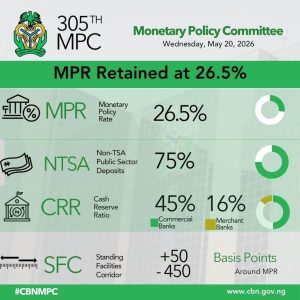
Committee retains Cash Reserve Ratio at 45% for commercial banks and standing facilities corridor unchanged

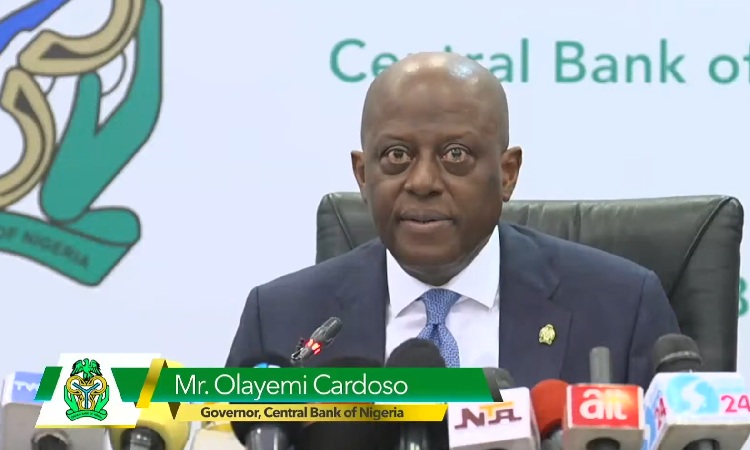
The Central Bank of Nigeria (CBN) has opted to maintain its benchmark interest rate at 26.5% following the conclusion of its 305th Monetary Policy Committee (MPC) meeting.
In a briefing held after the two-day session on May 19th and 20th, 2026, the committee announced its decision to hold all major policy parameters steady to anchor inflation expectations and safeguard macroeconomic stability. Alongside the Monetary Policy Rate (MPR), the MPC retained the standing facilities corridor at +50 to -450 basis points and kept the Cash Reserve Requirement (CRR) at 45% for deposit money banks.
Inflation and the “Transitory” Surge
The decision comes as Nigeria faces a marginal uptick in headline inflation, which rose to 15.69% in April 2026 from 15.38% the previous month. This increase was primarily fueled by food inflation, which climbed to 16.06%, reflecting high transportation and logistics costs.
Despite these figures, the committee described the current inflationary pressure as “transitory” and largely induced by external shocks, specifically spillovers from the Middle East crisis that have impacted global energy prices. Governor Olayemi Cardoso noted that prior policy reforms, including exchange rate stability and strengthened monetary transmission, have significantly mitigated the pass-through of these global shocks to the domestic economy.
Banking Sector and Growth Outlook
The MPC highlighted the successful conclusion of the banking recapitalization exercise, which has resulted in 33 banks emerging with significantly stronger financial soundness indicators. The Governor emphasized that this process was “relatively seamless” and reflects a strong belief among investors in the Nigerian economy.
On the growth front, the committee reported that real GDP grew by 4.0% in the fourth quarter of 2025, supported by expansions in the industry, agriculture, and services sectors. The oil sector also saw a boost, growing by 6.79% due to improved downstream refining.
External Buffers and Exchange Rate Stability
Nigeria’s external reserves remain a point of strength, standing at $49.49 billion as of May 15, 2026. This buffer is sufficient to cover 9.04 months of imports for goods and services, providing a solid foundation for exchange rate stability.
Addressing rumors of heavy market intervention, Governor Cardoso clarified that the CBN’s intervention in 2025 was minimal, representing only about 1.2% to 1.3% of total market turnover. He noted that the foreign exchange market has deepened significantly, with daily turnover now averaging roughly 550million and occassionally spiking to 1 billion.
Future Outlook
While global growth is expected to moderate in 2026 due to geopolitical tensions and tighter financial conditions, the MPC remains optimistic about the domestic path. The committee reaffirmed its commitment to a forward-looking, evidence-based policy framework aimed at achieving price stability.
The next MPC meeting is scheduled for July 20th and 21st, 2026.